
Hair thinning rarely happens for just one reason. It can develop gradually with hereditary hair loss, appear after a period of increased shedding, or occur alongside hormonal, nutritional or scalp-related concerns. Because the cause matters, choosing a hair treatment should begin with understanding what is actually happening to the scalp and hair follicles. PRP treatment …

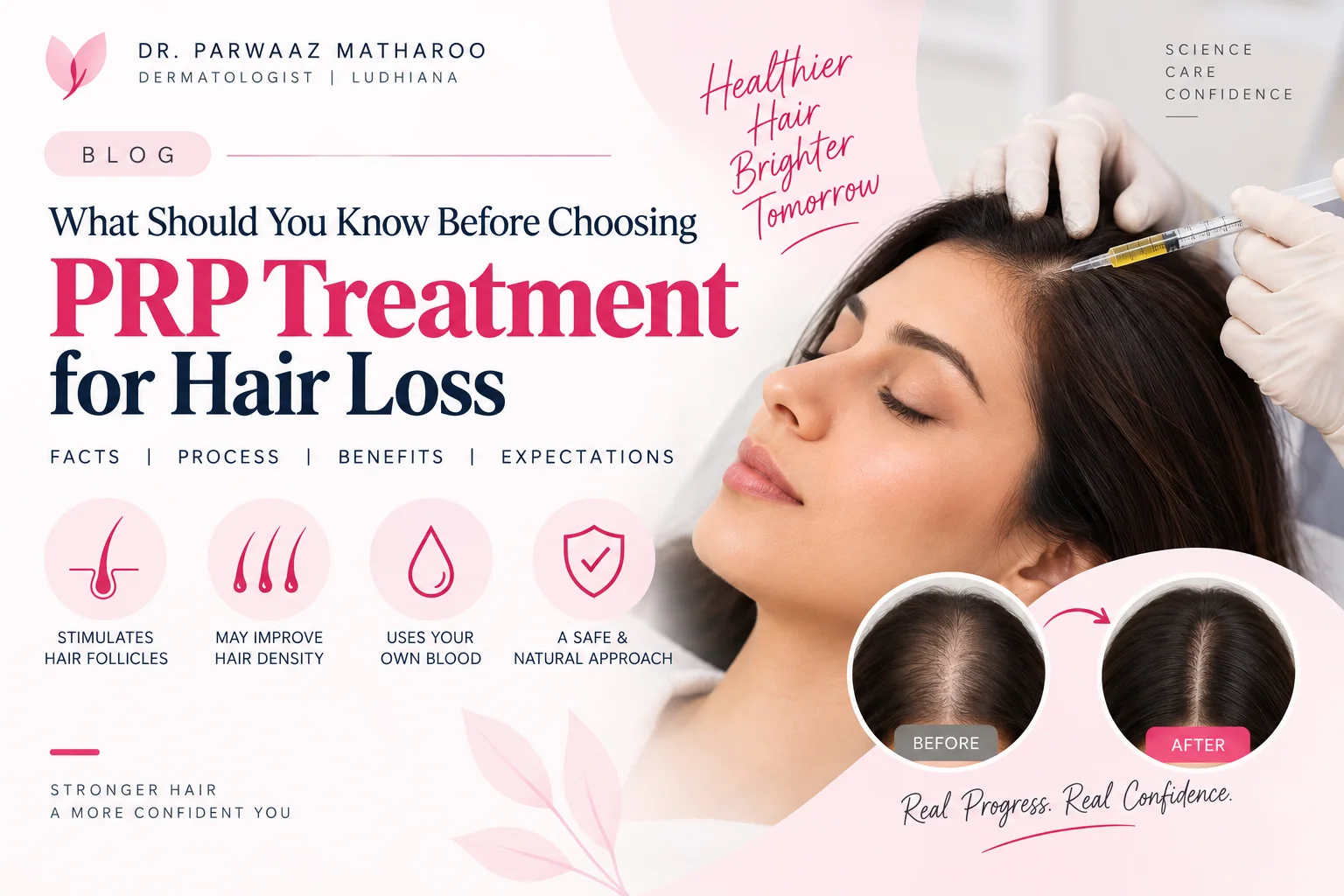
Hair thinning rarely happens for just one reason. It can develop gradually with hereditary hair loss, appear after a period of increased shedding, or occur alongside hormonal, nutritional or scalp-related concerns. Because the cause matters, choosing a hair treatment should begin with understanding what is actually happening to the scalp and hair follicles.
PRP treatment has become one of the options dermatologists may consider for selected patients with pattern hair loss. The treatment uses platelet-rich plasma prepared from the patient’s own blood and is designed to support the environment around existing hair follicles. Clinical research has reported improvements in hair density in some people with androgenetic alopecia, although results vary and treatment protocols are not completely standardised.
For someone considering PRP for hair loss, the more useful question is not simply whether PRP works. It is whether PRP treatment is appropriate for your type of hair loss, what can realistically be expected and how it fits into your overall treatment plan.
What Is PRP Treatment for Hair Loss
PRP stands for Platelet-Rich Plasma.
The treatment starts with a small blood sample taken from the patient. The sample is processed to separate the platelet-rich portion of the plasma. This preparation is then injected into selected areas of the scalp.
Platelets contain growth factors and other biological substances involved in tissue repair and cellular activity. Researchers have therefore studied PRP as a way of supporting hair follicle activity in androgenetic alopecia.
PRP is an autologous treatment, which means the material used comes from the same person receiving the procedure.
Why Is PRP Being Used for Hair Loss
Pattern hair loss is associated with progressive changes in susceptible hair follicles. Over time, affected follicles can produce thinner and shorter hairs.
PRP has been investigated because its biological components may influence processes around the hair follicle. Studies have reported improvements in measures such as hair density and, in some research, hair thickness.
However, PRP should not be presented as a guaranteed solution for every type of hair loss.
The diagnosis, stage of hair thinning, follicle condition and treatment protocol all influence the possible outcome.
Which Type of Hair Loss May Benefit From PRP
The strongest body of research around PRP is related to androgenetic alopecia, also known as pattern hair loss.
It can affect both men and women and usually follows a recognisable pattern of thinning. PRP may be considered when a dermatologist identifies suitable follicles that may still respond to treatment.
Other forms of hair loss can have completely different causes and may require different treatments.
For example, sudden shedding after an illness, nutritional deficiency or major stress is not the same condition as progressive hereditary hair thinning.
That is why diagnosis should come before choosing PRP.
Why Should You Diagnose Hair Loss Before Treatment
Hair loss is a symptom, not a single disease.
A person may notice more hair on a pillow or in the shower and assume that PRP is the answer. However, excessive shedding can have many possible causes.
A dermatologist may consider factors such as
- The pattern of hair loss
- How quickly the thinning developed
- Scalp health
- Family history
- Recent illness
- Hormonal changes
- Nutrition
- Medications
- Existing medical conditions
- Previous hair treatments
The American Academy of Dermatology also recommends identifying the type of hair loss because different forms require different treatment approaches.
How Does PRP Treatment Work
Once PRP is prepared from the patient’s blood, it is injected into selected areas of the scalp.
The purpose is to introduce a concentrated platelet-rich preparation around areas where hair follicles are being affected by hair thinning.
Research suggests that platelet-derived growth factors may influence cellular activity and the follicular environment. However, the exact biological response can vary between patients and the mechanisms are still being studied.
This is one reason professional treatment planning matters.
What Happens During a PRP Session
A typical PRP session involves three basic stages.
Blood Collection
A small amount of blood is collected from the patient.
PRP Preparation
The blood is processed using a centrifugation or separation method to prepare the platelet-rich portion.
Scalp Injections
The prepared PRP is injected into selected areas of the scalp.
The American Academy of Dermatology describes PRP as a procedure involving blood collection, separation and scalp injections, with the injection portion taking around 10 minutes in its patient guidance.
The exact technique and preparation method can vary between clinics.
How Many PRP Sessions Are Usually Needed
There is no universal PRP schedule for every patient.
Published clinical recommendations have commonly evaluated multiple sessions rather than relying on a single treatment. Indian dermatology recommendations describe three to five sessions at approximately one-month intervals for androgenetic alopecia.
The American Academy of Dermatology also describes an initial series followed by maintenance treatments for some patients with pattern hair loss.
Your dermatologist can determine the appropriate schedule based on your diagnosis and response.
When Can You Expect Results From PRP
Hair does not grow overnight, so PRP results should be assessed over time rather than immediately after treatment.
Clinical studies commonly evaluate hair changes several months after treatment. Research has reported improvements in hair density at three and six months in some patients with androgenetic alopecia.
The American Academy of Dermatology notes that some patients may notice less hair loss within a few months, followed by thickening or regrowth.
Individual results can differ.
Can PRP Make Hair Look Thicker
PRP may improve hair density or thickness in suitable patients.
A systematic review of randomized and prospective studies found potential benefits for male androgenetic alopecia, including improvements in hair density and hair count, but also highlighted limitations in study quality and variation between studies.
So the goal should be realistic improvement rather than expecting an identical result for everyone.
Can PRP Stop Hair Loss Permanently
PRP should not be described as a permanent cure for pattern hair loss.
Androgenetic alopecia is a continuing condition, which means long-term management may be needed. The American Academy of Dermatology specifically notes that PRP is not a permanent solution and maintenance treatments may help maintain results.
This makes follow-up an important part of treatment.
Can PRP Be Combined With Other Hair Treatments
PRP does not always have to be used on its own.
Depending on the diagnosis, a dermatologist may consider combining it with established medical treatments. Research has compared PRP with topical minoxidil and has also evaluated combination approaches.
A 2026 systematic review and meta-analysis comparing PRP and topical minoxidil found no significant difference between the two for hair density, while several other outcomes showed differences. The authors also highlighted the need to interpret the findings in the context of the available evidence.
The right combination depends on the patient rather than a fixed formula.
Is PRP Treatment Suitable for Men and Women
PRP has been studied in both male and female pattern hair loss.
The important consideration is the diagnosis rather than gender alone.
A dermatologist looks at the distribution of thinning, follicle condition, medical history and other relevant factors before deciding whether PRP is suitable.
Is PRP Treatment Safe
Published studies generally describe PRP as a minimally invasive procedure with mostly mild and temporary treatment-related effects. Research has reported effects such as scalp discomfort or tenderness, while serious adverse events appear uncommon in the available studies.
As with any procedure involving injections, individual risks should be discussed with the treating dermatologist.
What Can You Expect After PRP
Some temporary tenderness or sensitivity can occur after scalp injections.
Your dermatologist will provide specific aftercare instructions based on the treatment technique and your scalp condition.
More importantly, patients should understand that the biological process involved in hair growth takes time. Looking for a dramatic change immediately after a session can create unrealistic expectations.
Why PRP Preparation Matters
One of the less discussed aspects of PRP is that not every PRP preparation is identical.
Studies have used different systems, platelet concentrations, preparation techniques, injection methods and treatment schedules. This variation makes it difficult to compare every PRP study directly. Recent research continues to identify protocol variation as an important issue in PRP research.
For this reason, the phrase PRP treatment alone does not describe every detail that can influence the procedure.
What Makes a Good PRP Treatment Plan
A thoughtful PRP plan should start with diagnosis.
It should consider
- The actual cause of hair loss
- The stage of hair thinning
- The condition of the scalp
- The available treatment options
- Whether additional treatment is required
- The expected treatment timeline
- Follow-up requirements
- The possibility of maintenance treatment
This approach makes PRP part of a complete hair management strategy rather than treating it as a standalone procedure.
PRP Treatment Versus Hair Transplant
PRP and hair transplantation are different treatments.
PRP aims to support existing hair follicles through scalp injections.
A hair transplant involves moving hair follicles from one area of the scalp to another. The American Academy of Dermatology notes that PRP may sometimes be used alone or before a hair transplant, depending on the patient’s situation.
The appropriate option depends on the amount and pattern of hair loss and the condition of the available follicles.
What Should You Tell Your Dermatologist Before PRP
Before undergoing PRP treatment, tell your dermatologist about your medical history and any medicines or supplements you take.
It is also useful to discuss
- When your hair loss started
- Whether shedding is sudden or gradual
- Whether family members have similar hair loss
- Previous treatments
- Scalp itching or scaling
- Recent illness
- Major dietary changes
- Hormonal changes
- Any previous procedures
These details can help your dermatologist understand the bigger picture.
When Should You See a Dermatologist for Hair Loss
A consultation is worth considering when hair thinning continues, becomes more noticeable or starts affecting your confidence.
You should also seek professional assessment if hair loss is sudden, patchy or accompanied by scalp symptoms.
Early evaluation does not automatically mean you need PRP. It simply gives you a better opportunity to identify the cause and discuss appropriate treatment options.
PRP Treatment in Ludhiana
If you are searching for PRP treatment in Ludhiana, the first step should be a proper assessment of your hair and scalp.
Dr. Parwaaz Matharoo, M.D. Dermatology, provides personalised dermatological care for hair and scalp concerns. As a dermatologist in Ludhiana, she evaluates the pattern and possible cause of hair loss before discussing whether PRP or another treatment approach is suitable.
The focus is on choosing treatment according to the patient’s condition rather than recommending the same procedure for everyone.
Frequently Asked Questions About PRP Treatment
Is PRP treatment good for hair loss
PRP may be useful for selected patients, particularly those with androgenetic alopecia. Research has reported improvements in hair density, but results vary and the quality of evidence is not uniform across studies.
How many PRP sessions are required
Multiple sessions are commonly used. Indian dermatology recommendations describe three to five sessions at approximately monthly intervals for androgenetic alopecia, although the final plan should be personalised.
How quickly does PRP show results
Hair changes generally take several months to become noticeable. Clinical studies commonly assess outcomes at three and six months.
Can PRP completely regrow lost hair
PRP is not a guaranteed method for complete regrowth. Its potential benefit depends on the diagnosis and condition of the hair follicles.
Can women undergo PRP treatment
Yes. PRP has been studied in both men and women with pattern hair loss.
Can PRP be combined with minoxidil
It may be combined with minoxidil in selected treatment plans. Research has evaluated both treatments individually and together, with evidence continuing to develop.
Is PRP a permanent solution
No. PRP should not be described as a permanent cure for pattern hair loss. Maintenance treatment may be required depending on the individual.
Does PRP treatment hurt
PRP involves small injections into the scalp, so some discomfort can occur. Your dermatologist can discuss ways to make the procedure more comfortable.
Is PRP suitable for every type of hair loss
No. PRP has been studied most extensively for androgenetic alopecia. Other causes of hair loss need their own diagnosis and treatment approach.
Should I get PRP without a hair loss diagnosis
It is better to have the cause of hair loss assessed first. Different types of hair loss can look similar but require very different treatments.
The Bottom Line
PRP treatment can be a useful option for selected patients with pattern hair loss, but it should not be treated as a one-size-fits-all solution.
The evidence suggests that PRP can improve measures such as hair density in some patients, while current research also shows considerable variation in preparation methods, treatment schedules and study quality.
The most important step is therefore not choosing PRP first. It is understanding why the hair is thinning and then selecting a treatment plan that matches the diagnosis, expectations and long-term needs of the patient.
About Dr. Parwaaz Matharoo
Dr. Parwaaz Matharoo, M.D. Dermatology, provides personalised dermatological care for skin, hair and scalp concerns in Ludhiana. Hair loss treatment is planned after evaluating the individual pattern and possible underlying causes.
Book an Appointment
It’s easy and free!


