
Psoriasis is a chronic inflammatory skin condition that can cause dry, thickened and raised patches on the skin. These patches may have scales and can be itchy, irritated or uncomfortable. Psoriasis can affect different areas of the body, including the elbows, knees, scalp, hands, feet and nails. Some people also develop symptoms involving their joints. …

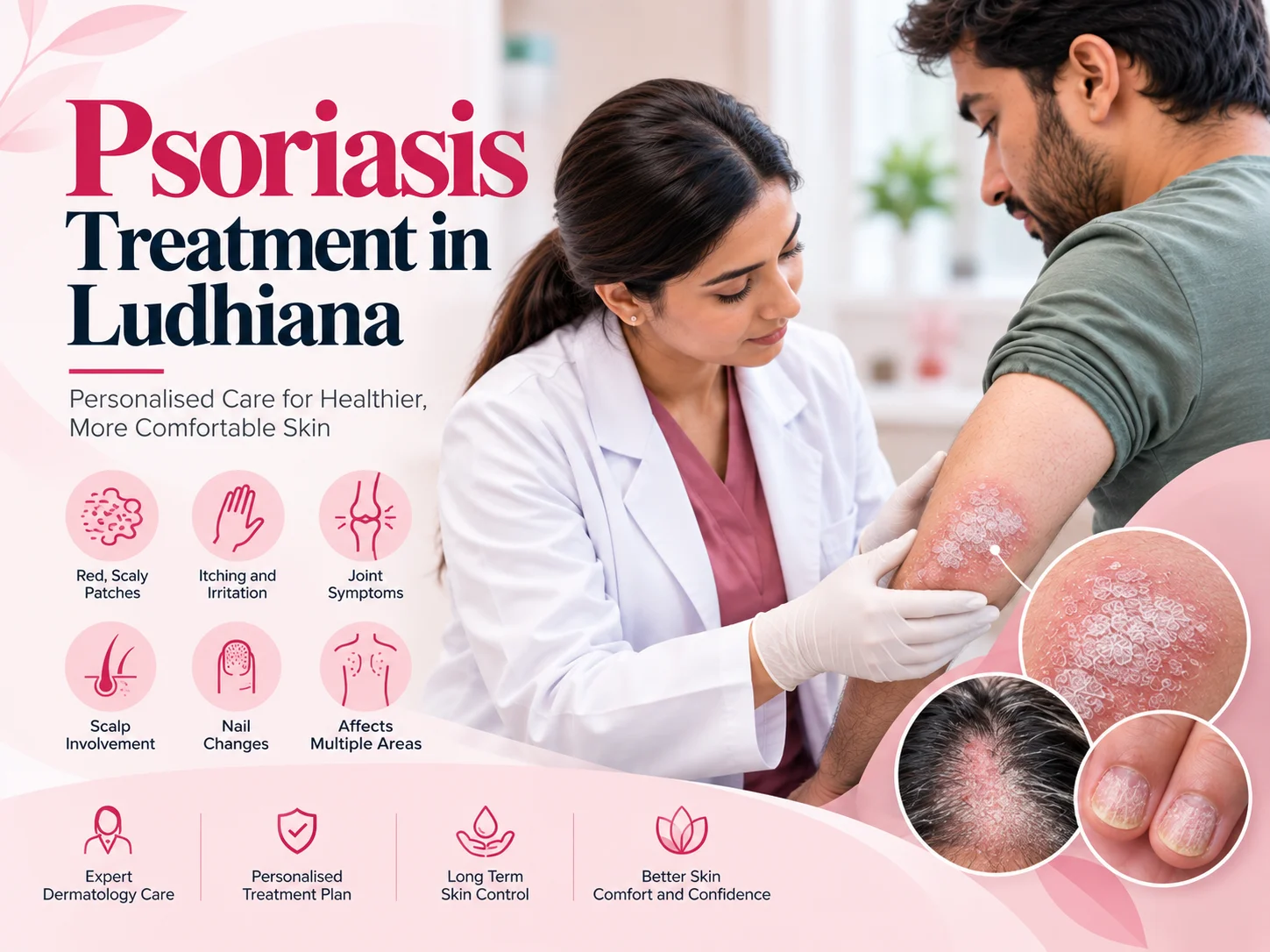
Psoriasis is a chronic inflammatory skin condition that can cause dry, thickened and raised patches on the skin. These patches may have scales and can be itchy, irritated or uncomfortable. Psoriasis can affect different areas of the body, including the elbows, knees, scalp, hands, feet and nails. Some people also develop symptoms involving their joints. The appearance of psoriasis can vary from one person to another. This is why getting the diagnosis right is an important first step before choosing treatment. If you are looking for psoriasis treatment in Ludhiana, a consultation with a dermatologist can help determine the type of psoriasis you have, how extensive it is and which treatment approach may be appropriate.
What Does Psoriasis Look Like
Psoriasis can appear differently depending on its type and the area affected.
Common signs can include
- Thick or raised patches
- Dry skin
- Scaling
- Itching
- Red or darker-looking patches depending on skin tone
- Cracking or soreness
- Nail changes
- Scalp scaling
- Joint pain or stiffness in some patients
Plaque psoriasis is the most common form and typically causes raised patches covered with scale. Psoriasis can also affect the scalp and nails, and some people develop joint symptoms associated with psoriatic arthritis.
Not every itchy or scaly patch is psoriasis, though. Conditions such as eczema, fungal infections and other inflammatory skin conditions can sometimes appear similar.
A dermatologist can help distinguish between them.
When Should You See a Dermatologist for Psoriasis
You do not have to wait for psoriasis to become extensive before seeking professional care.
Consider seeing a dermatologist in Ludhiana if you notice persistent scaly patches, recurring skin inflammation, unexplained itching or skin changes that do not improve with your usual skincare.
A consultation becomes particularly important when
- Psoriasis keeps returning
- Patches are becoming thicker
- The affected area is increasing
- Itching is interfering with daily activities
- The scalp is involved
- Nails are changing
- Skin is cracking or becoming painful
- You experience joint pain or morning stiffness
Early assessment can help establish an appropriate treatment and monitoring plan.
Why Is a Dermatologist Important for Psoriasis Treatment
Psoriasis is not simply dry skin that needs a stronger moisturiser.
It is a chronic inflammatory condition, and treatment depends on factors such as the type of psoriasis, areas affected, severity, impact on daily life and other health conditions.
A skin specialist in Ludhiana can assess these factors before recommending treatment.
This matters because treatment that works for a small patch on the elbow may not be appropriate for psoriasis affecting the face, scalp, nails or body folds.
The treatment approach also needs to consider any other medicines you are taking.
How Is Psoriasis Diagnosed
A dermatologist generally starts with a clinical examination.
The doctor may look at the affected skin, scalp and nails and ask questions about your symptoms and medical history.
You may also be asked about
- When the patches first appeared
- Whether they come and go
- Itching or discomfort
- Family history of psoriasis
- Previous treatment
- Nail changes
- Joint pain or stiffness
- Recent illness or stress
- Current medicines
In some situations, a small skin sample may be needed to confirm the diagnosis or rule out another condition.
The diagnosis is important because psoriasis can resemble other skin conditions.
What Are the Treatment Options for Psoriasis
There is no single treatment that works for every person with psoriasis.
Depending on the condition, a dermatologist may consider topical medicines, phototherapy or medicines that work throughout the body. Some patients may need a combination of treatments.
Topical Treatment for Psoriasis
Topical medicines are applied directly to affected skin.
They are commonly used for mild psoriasis and can also form part of treatment for more extensive disease.
Depending on the patient’s condition, a dermatologist may prescribe medicines such as corticosteroids, vitamin D analogues, topical calcineurin inhibitors or other topical treatments.
Some topical medicines are designed to reduce inflammation, while others help control scaling or excessive skin cell growth.
The strength and duration of treatment matter.
For example, strong topical steroids should not be used casually or for prolonged periods without medical supervision because their safety depends on factors such as the treatment area, strength and duration.
Moisturisers and Skin Care
Moisturising is an important part of psoriasis care.
Psoriasis can make the skin dry and scaly, and regular moisturisation can help support the skin barrier and reduce dryness.
A dermatologist may recommend a thicker cream, ointment or another suitable moisturiser depending on your skin.
Applying moisturiser after bathing can help retain moisture.
However, moisturiser alone may not control active psoriasis.
It works best as part of an overall management plan.
Phototherapy for Psoriasis
Phototherapy uses controlled light under medical supervision.
It may be considered when topical treatment is not sufficient or when psoriasis affects larger areas of the body.
Phototherapy needs to be planned and monitored by a dermatologist. Using tanning beds or deliberately exposing the skin to sunlight is not an appropriate substitute for medical phototherapy and can damage the skin.
Oral and Systemic Treatments
Some patients need treatment that works throughout the body.
This may be considered when psoriasis is more extensive, difficult to control or significantly affecting quality of life.
Depending on the patient’s condition, systemic treatment can include oral medicines or biologic medicines.
These treatments require medical evaluation and monitoring because the choice depends on the patient’s psoriasis, overall health, medications and other risk factors.
Biologic Treatment
Biologic medicines target specific parts of the immune response involved in psoriasis.
They may be considered for people with moderate to severe psoriasis or psoriatic arthritis, depending on individual circumstances.
Biologic treatment is not something patients should select based on online recommendations.
A dermatologist needs to determine whether it is appropriate and which treatment is suitable.
Can Psoriasis Affect the Scalp and Nails
Yes.
Psoriasis can affect the scalp and nails as well as the skin.
Scalp psoriasis can cause scaling and plaques that may extend beyond the hairline.
Nail psoriasis can cause changes such as thickening, discoloration, pitting or separation of the nail from the nail bed.
These areas can require different treatment approaches, which is why you should tell your dermatologist about symptoms even when they appear unrelated to the main skin problem.
Can Psoriasis Cause Joint Problems
Psoriasis can be associated with psoriatic arthritis.
Symptoms can include joint pain, swelling and stiffness.
If you have psoriasis and notice persistent joint symptoms, tell your dermatologist rather than treating the skin alone.
The American Academy of Dermatology recommends that dermatologists monitor patients for signs of psoriatic arthritis during follow-up.
Early evaluation can help determine whether another specialist should also be involved.
What Can Trigger Psoriasis Flare Ups
Psoriasis can have periods when symptoms become more noticeable.
Triggers can vary between individuals.
Possible triggers can include
- Stress
- Illness or infection
- Skin injury
- Certain medicines
- Smoking
- Alcohol
- Environmental changes
- Stopping treatment without medical guidance
Not every trigger affects every person.
Keeping track of when flare-ups occur can help you and your dermatologist identify possible patterns.
Can You Treat Psoriasis Without a Prescription
Very mild psoriasis may sometimes be managed with suitable non-prescription products, particularly moisturisers and certain scale-softening products.
However, persistent or widespread psoriasis should not be managed indefinitely through self-treatment.
The American Academy of Dermatology notes that moisturisers can benefit people with psoriasis, while other over-the-counter treatments may be appropriate for selected mild cases. It also recommends seeing a dermatologist when these approaches are not providing the desired control.
Avoid using strong steroid creams or combination creams without medical advice.
Why Should You Avoid Random Steroid Creams
Many people with persistent rashes start using steroid-containing creams without knowing what the underlying condition is.
This can create problems when the diagnosis is incorrect or when the medicine is used on the wrong area for too long.
Corticosteroids can be useful psoriasis treatments when appropriately prescribed, but the strength, location and duration of use matter.
This is one reason a consultation with a skin specialist in Ludhiana is preferable to repeatedly changing creams on your own.
How Do You Choose a Dermatologist Near Me for Psoriasis
When people search dermatologist near me, they are often looking for quick access to professional care.
Location is useful, but it should not be your only consideration.
When choosing a dermatologist for psoriasis, consider
Dermatology Qualification
Check whether the doctor has a recognised dermatology qualification.
Experience With Medical Skin Conditions
Psoriasis is a medical skin condition, so look for a dermatologist who provides medical dermatology care.
Individualised Treatment
Treatment should be selected according to your psoriasis type, severity, affected areas and medical history.
Follow Up
Psoriasis often needs ongoing management rather than one-time treatment. Regular follow-up allows your dermatologist to see whether the plan is working and modify it when necessary.
Clear Treatment Guidance
You should understand how to use prescribed medicines, how long to use them and when to return for review.
How Do You Choose the Best Dermatologist in Ludhiana for Psoriasis
Someone searching for the best dermatologist in Ludhiana may compare several doctors before booking a consultation.
Rather than relying only on rankings or promotional claims, look at relevant qualifications and whether the dermatologist provides care for psoriasis and other medical skin conditions.
You can also consider
- Dermatology qualification
- Experience with chronic skin conditions
- Consultation approach
- Treatment options
- Follow-up care
- Clinic accessibility
- Clear patient communication
The right dermatologist depends on your individual medical needs.
What About the Best Skin Doctor in Ludhiana
The term best skin doctor in Ludhiana is commonly used in online searches, but “best” can mean different things to different patients.
Someone with mild plaque psoriasis may need a different type of care from someone with extensive psoriasis, scalp involvement or joint symptoms.
Instead of choosing a doctor only because a website uses the word “best”, look for a qualified dermatologist who can diagnose your condition and create an appropriate treatment plan.
Psoriasis Treatment in Ludhiana at Dr. Parwaaz Matharoo
Dr. Parwaaz Matharoo is an M.D. in Dermatology, Venereology and Leprosy and provides dermatology care in Ludhiana. Her professional information also lists a Fellowship in Aesthetics and Lasers.
For patients looking for psoriasis treatment in Ludhiana, the consultation can focus on understanding the type and extent of the condition before treatment is selected.
This is particularly important because psoriasis may involve different parts of the body and may require different treatment approaches.
A dermatology consultation can help assess the skin and discuss appropriate medical treatment, skincare and follow-up according to the patient’s condition.
What Should You Expect During Psoriasis Treatment
Psoriasis management is usually not about treating the skin once and forgetting about it.
Your dermatologist may monitor
- Changes in plaques
- Itching
- Scaling
- New affected areas
- Scalp involvement
- Nail changes
- Joint symptoms
- Response to treatment
- Treatment-related side effects
Follow-up appointments allow the treatment plan to be adjusted when needed. The AAD specifically notes that follow-up helps dermatologists assess treatment response, modify treatment and monitor for psoriatic arthritis and nail involvement.
Can Psoriasis Be Permanently Cured
Psoriasis is generally considered a chronic condition.
Treatment can help control symptoms, reduce plaques and improve skin health, but patients should be cautious about claims of a guaranteed permanent cure.
The treatment goal is often long-term disease control and management.
Some people experience periods when their skin becomes much clearer, while symptoms can return later.
Regular follow-up helps manage these changes.
Psoriasis Skin Care at Home
Medical treatment and everyday skin care work together.
Helpful habits may include
- Using a suitable moisturiser regularly
- Avoiding harsh scrubbing
- Keeping showers comfortably warm rather than very hot
- Avoiding unnecessary skin irritation
- Following prescribed treatment consistently
- Identifying personal triggers
- Protecting the skin from injury
If a product causes burning or irritation, discuss it with your dermatologist rather than assuming that irritation means the treatment is working.
Frequently Asked Questions
What is the best treatment for psoriasis?
There is no single treatment that works best for everyone. Treatment depends on the type, severity, location and individual medical factors.
Can psoriasis be cured permanently?
Psoriasis is generally a chronic condition. Treatment focuses on controlling symptoms and maintaining the skin rather than promising a permanent cure.
Which doctor should I see for psoriasis?
A dermatologist is the appropriate specialist for diagnosing and treating psoriasis.
Can a skin specialist in Ludhiana treat scalp psoriasis?
Yes. Dermatologists can assess scalp psoriasis and select treatment according to the location and severity of the condition.
Can psoriasis affect the nails?
Yes. Nail changes can occur with psoriasis and should be discussed with your dermatologist.
Can psoriasis affect the joints?
Yes. Psoriasis can be associated with psoriatic arthritis. Joint pain, swelling or stiffness should be reported to your dermatologist.
How do I find a dermatologist near me for psoriasis?
Look for a qualified dermatologist who treats medical skin conditions and provides appropriate follow-up care. Location is useful, but qualifications and relevant clinical care are also important.
Can I use steroid cream for psoriasis without seeing a doctor?
Some mild corticosteroid products are available without prescription in certain markets, but stronger steroids and prolonged use require medical guidance. The treatment area and duration affect safety.
Can moisturiser help psoriasis?
Yes. Regular moisturisation can help reduce dryness and support the skin barrier, but moisturiser alone may not control active psoriasis.
Conclusion
Psoriasis needs more than a quick cream recommendation.
The condition can affect different parts of the skin, scalp and nails, and some patients may also develop joint symptoms. Treatment therefore needs to be based on the type and severity of psoriasis, the areas involved and the patient’s overall health.
If you are searching for psoriasis treatment in Ludhiana, dermatologist Ludhiana, skin specialist in Ludhiana, dermatologist near me or a skin doctor Ludhiana, a proper dermatology consultation is a useful first step.
Dr. Parwaaz Matharoo provides dermatology care in Ludhiana, where psoriasis can be assessed and managed according to the individual patient’s condition and treatment needs.
The focus should be on proper diagnosis, personalised treatment and long-term control, rather than trying random creams or following a treatment simply because it worked for someone else.
Book an Appointment
It’s easy and free!


